Print

High Hydration Roman Pizza Bianca with Poolish


  • Author: Leaven Foods
  • Total Time: 20 hours 30 minutes
  • Yield: 1x – 660g dough ball for making a single Roman Pizza Bianca

Description

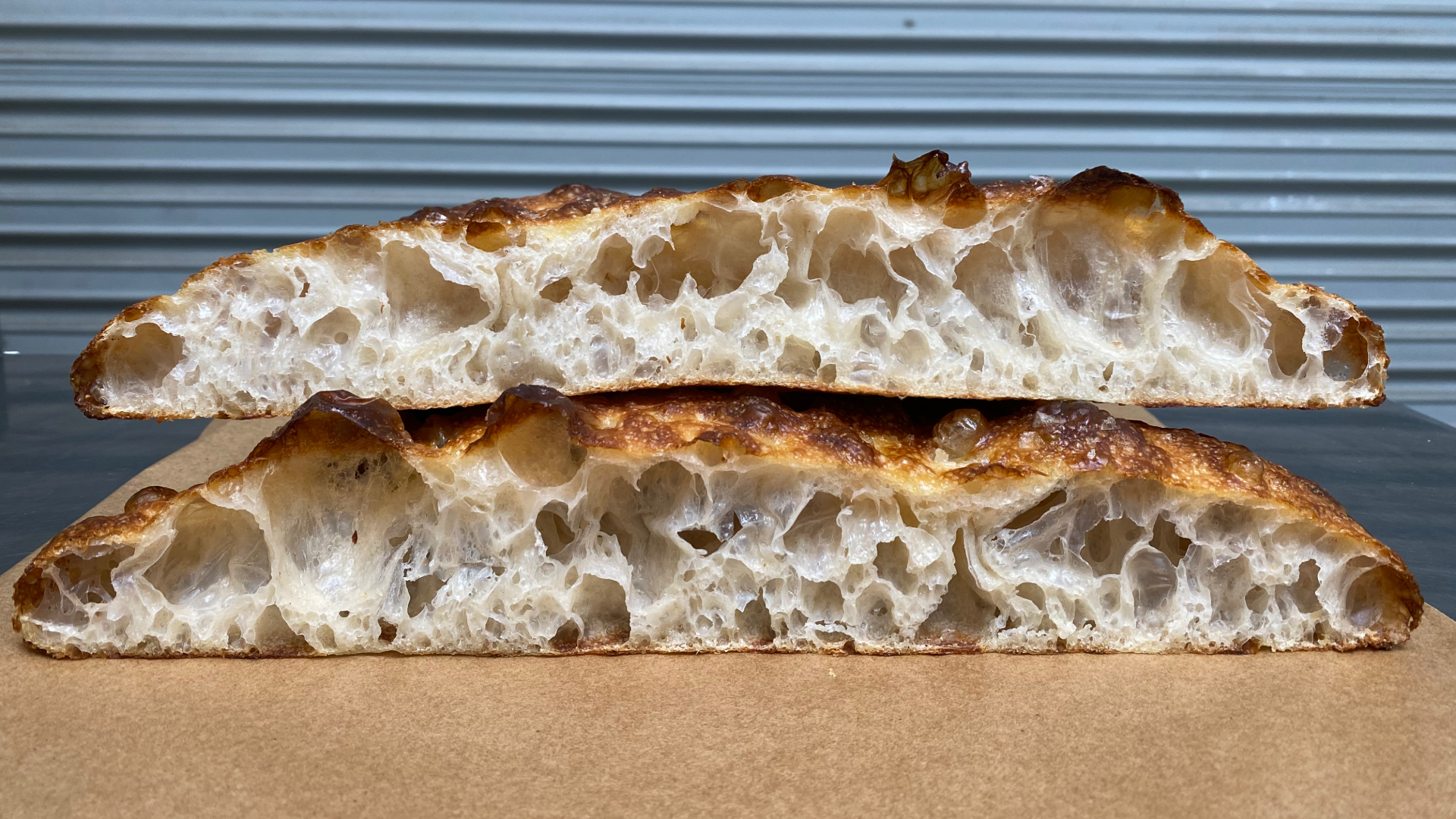
This dough creates airy Roman Pizza Bianca with an irregular, open-crumb structure. Due to the long mix time and high hydration, it is imperative to use cold water, or it will be difficult to develop the gluten properly. This recipe utilizes a poolish, resulting in a dough with more depth of flavor and a airier lighter crumb.


Ingredients

Units

Equipment:

  • Mixer
  • Digital Thermometer
  • Digital Scale

Poolish Ingredients (Amount – Baker’s %):

  • 122.5 g Bread Flour (12-13% protein) – 100%
  • 122.5 g Room Temperature Water (75℉ or 24℃) – 100%
  • 0.37 g Leaven Foods All Purpose or Wild Yeast – 0.3%

Final Dough Ingredients (Amount – Baker’s %):

  • 227.5 g Bread Flour (12-13% protein) – 65%
  • 174.5 g Water – 50%
  • 7g Salt – 2%
  • 245.4 g Poolish – 35%*

Instructions

  • Mix Poolish –  Mix the poolish by combining the poolish ingredients until completely incorporated. Cover and leave at room temperature (70-75℉/21-24℃ )  for 16 hours overnight until it doubles in size and has bubbles on the surface.
  • Incorporate –  Combine the ingredients for the final dough by adding the water, flour, salt, and poolish to the mixing bowl and mixing speed 1 for 5 minutes or until incorporated.

  • Mix –  After incorporating the ingredients for the final dough, gradually increase the speed to 8, mixing for 1 minute at each speed from 2 to 8. Continue mixing at speed 8 until the dough pulls away clean from the mixing bowl. Once the dough pulls clean, it needs 3 more minutes at speed 8. At this point the dough should be mostly smooth. Any remaining gluten development will be completed during the stretch and fold process. The desired temperature of the dough at the end of the mix is 74-78℉/23-26℃.

  • Bulk Retard- After mixing, transfer the dough to an oiled container. The dough will be sticky so it is helpful to wet hands with water before handling the dough. Cover the container and and let sit at room temperature (70-74℉/21-23℃ ). Perform two stretch and folds 30 minutes apart during the first hour of bulk fermentation. After performing the final stretch and fold transfer the container with the dough to the refrigerator (40℉ or 4℃) to bulk retard.  This dough requires 18 hours in the refrigerator to bulk retard but can be left for up to 96 hours (4 days).

  • Divide and Shape – Remove the dough from the refrigerator and let it rest for 1 hour.  Turn the dough out of its container on a floured surface. Using floured hands, shape the dough into a ball and place it in an oiled container. The container for shaped dough should be large enough for the dough to expand but tight enough that the dough can’t relax too much. An ideal container is a 2 quart round Cambro with a lid.

  • Proof & Bake –  Let the dough ball proof in the covered container in the warmest room available (75-80℉/24-27℃ ) for 4-5  hours.  During the final hour of proofing, preheat the oven to 500℉(260℃). If you plan to bake on a stone or steel instead of a sheet pan, place it in the oven while it preheats. Once proofing is complete, turn the dough out of its container onto an oiled baking sheet or onto oiled parchment paper if using a stone or steel. Drizzle additional olive oil over the top, dimple the dough, sprinkle with flaky sea salt, and bake for 14–16 minutes, or until golden brown.

Notes

* percentage of preferment calculated by % of prefermented flour

Mixing speed and times may vary depending on the mixer. The following protocol has been adapted for a 4.5 qt. KitchenAid® or similar mixer using a dough hook attachment.

Conversion Calculator